A faint signal, not a confirmed discovery
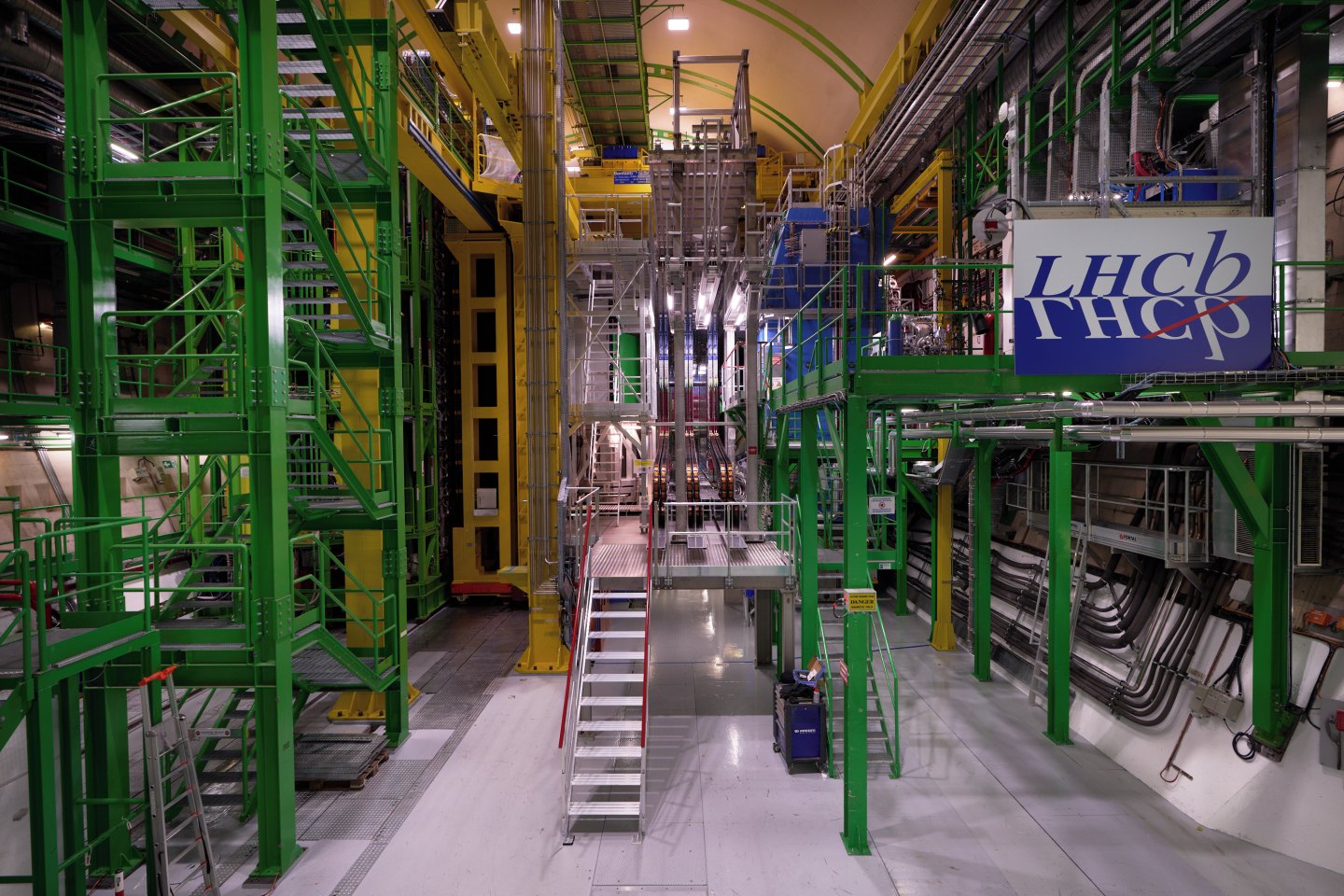
The LHCb collaboration announced new evidence on November 3 for an extraordinarily uncommon transformation: the decay of a particle called the B0 meson into a muon and an antimuon. Theory predicts that this happens approximately once in every ten billion decays of this type of meson. This is the first evidence obtained using data from a single experiment.
The result reaches a statistical significance of 3.2 sigma, enough to qualify as evidence but below the five-sigma threshold generally required to confirm an observation in particle physics. Muons resemble electrons but are heavier.
How the team found the signal
To identify that signal, the team combined records from 2024 and 2025 with data collected between 2011 and 2018. The upgraded detector can record collisions at up to five times its previous rate. More precise particle identification and analysis techniques helped distinguish the process being sought from many other collisions.
What it means and what remains to be checked
The significance goes beyond observing something difficult to find. These decays help test the Standard Model, the theory describing fundamental particles and their interactions. A difference between predictions and measurements could indicate the influence of particles that remain undiscovered. For now, the results are consistent with the model.
The same work provides more precise measurements of another rare decay, that of the Bs0 meson into two muons. The study is available as a scientific preprint, submitted on October 30. The next step will be to gather more evidence to determine whether the B0 signal reaches the level needed to confirm its observation. This announcement provides a more demanding test of known physics, but it does not yet establish the existence of new particles.
Sources and context
Sources used for this article. Follow the links to read the original material.
See the linked sources for more information. Corrections and contact →