In brief
- The image was released on October 22 and highlighted by NASA on October 28.
- N159 is about 161,000 light-years away.
- Scientific context helps explain the image’s colors.
Two dates and a distant region
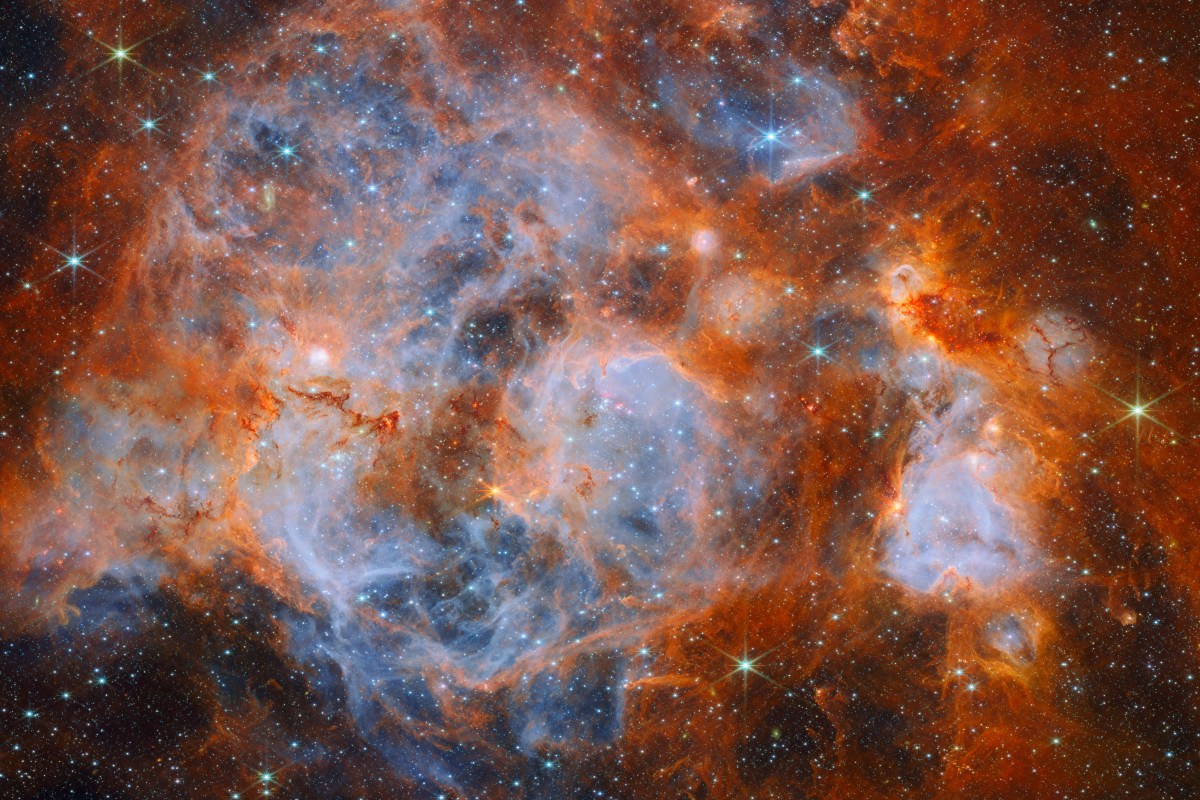
On October 28, NASA highlighted an image of N159, a star-forming region in the Large Magellanic Cloud, about 161,000 light-years away. ESA/Webb originally released the image on October 22. Neither date should be confused with when the objects we see were born.
Webb’s NIRCam covers a region roughly 230 light-years across. Massive stars emit radiation that ionizes the gas, while their winds help carve out cavities. This is a changing landscape, although a still image cannot show that process unfolding in real time.
Different colors tell different stories
ESA/Webb describes pale blue as ionized gas, orange as polycyclic aromatic hydrocarbon molecules, and dark red filaments as cold molecular gas shielding forming stars. These are clues to interpreting an infrared image, rather than colors to view without context.
A simple way to explore the picture is to find the bright cavities first, then trace the dark filaments. Comparing them helps distinguish regions exposed to stars from places where material still surrounds them.
Why a neighboring galaxy matters
The Large Magellanic Cloud contains fewer heavy elements than the Milky Way. For researchers, that difference helps investigate conditions relevant to star formation in the early universe.
The original image page provides a high-resolution version, credits and instrument details. It is worth checking before sharing: a publication date does not make the scene an event that happened today.
Sources and context
Sources used for this article. Follow the links to read the original material.
See the linked sources for more information. Corrections and contact →