Look beyond the spiral
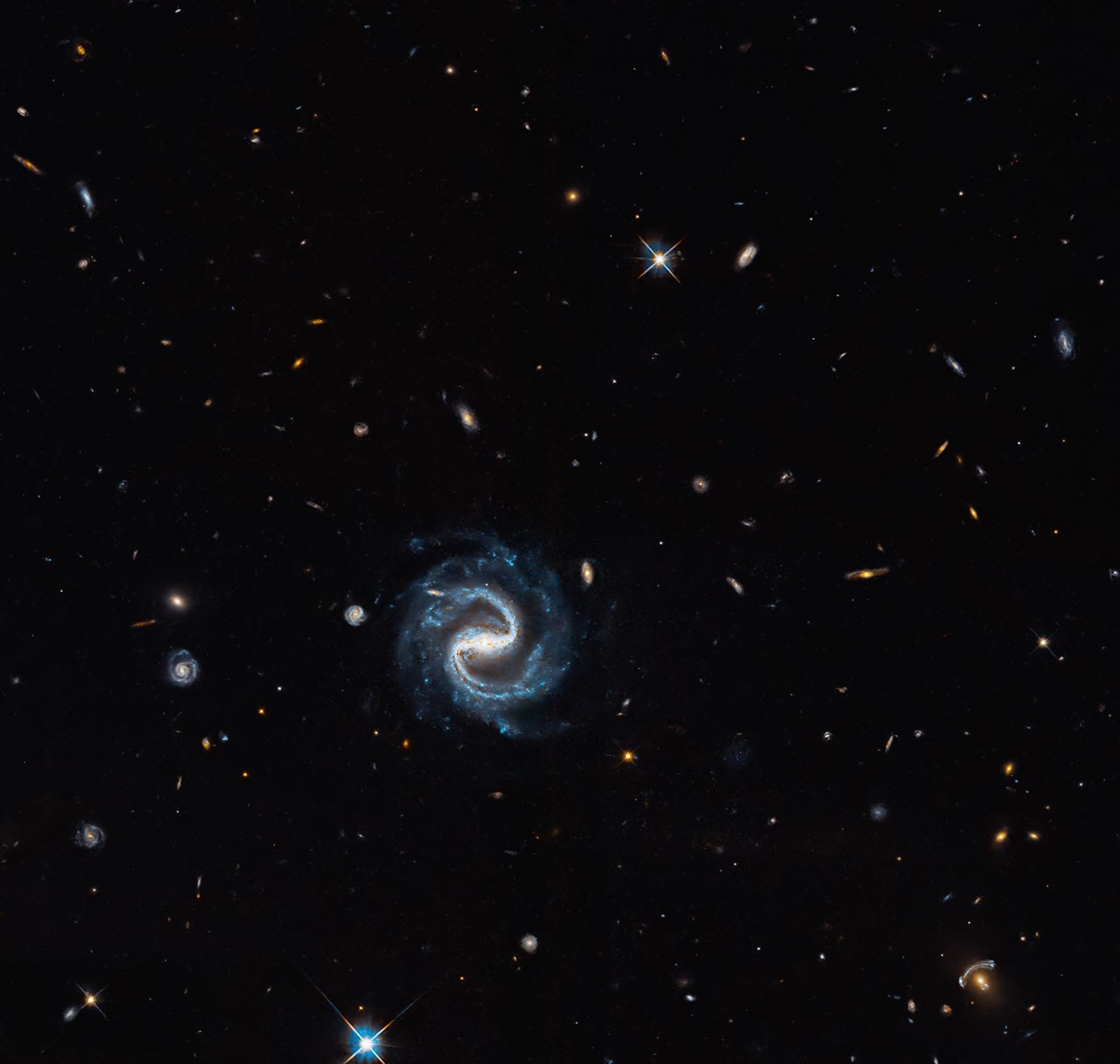
A spiral galaxy catches your eye first, but look toward the lower-right corner. The Hubble image discussed in a NASA release on October 22, 2026 shows a reddish galaxy beside two arcs: two images of the same, more distant galaxy.
The foreground object is about 4.5 billion light-years away; the background one is about 8 billion light-years away. The date refers to the published explanation, not to an image captured that day.
A magnifying lens without glass
Mass can curve spacetime and bend the path of light. When objects line up in the right way, that bending magnifies or distorts the image of the more distant object. This effect is called gravitational lensing.
Think of looking at a shape through glass that changes its appearance, except there is no glass here: gravity does the work. Studying these distortions helps researchers map dark matter, which cannot be seen directly like a bright star. This is not a direct photograph of dark matter.
Close-ups and panoramas work together
Hubble and the Roman telescope offer complementary views. Hubble studies individual regions in fine detail; Roman is designed to cover much wider areas of sky, mainly in infrared light. One does not make the other redundant.
You do not need to memorize every distance to enjoy this image. Start by finding the spiral, the reddish galaxy, and the arcs. Then return to the full view: what looked like an odd smudge turns out to be a clue to how light travels.
Sources and context
Sources used for this article. Follow the links to read the original material.
See the linked sources for more information. Corrections and contact →