
In brief
- Captured on November 1, 2009; selected by APOD on November 5, 2026.
- Pandora is also visible beside the rings.
- Cassini’s mission ended in 2017.
A recent feature, an archival photograph
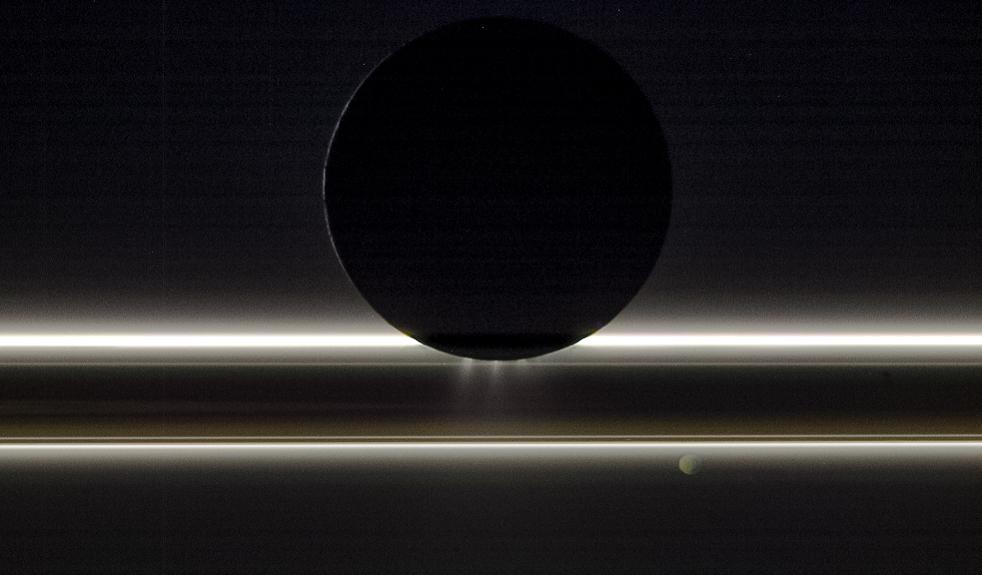
NASA’s Astronomy Picture of the Day for November 5, 2026, features a backlit view of Enceladus. The feature is recent; the photograph is not. Cassini took it on November 1, 2009, according to JPL’s original record. Mixing up those dates would suggest that a mission which has ended is still sending freshly captured pictures.
That distinction does not make it less interesting. The selection brings us back to a scene shaped by the direction of the light. Start with the large dark disc, then follow the bright lines crossing the frame.
What surrounds the silhouette
Sunlight comes from behind the scene, making the icy particles in the rings and the jets from Enceladus’s south polar region stand out. The small dot visible below is Pandora, another of Saturn’s moons. Its night side is faintly illuminated by light reflected from the planet.
JPL describes this as a natural-color photograph taken in visible light with Cassini’s narrow-angle camera. It is neither a generated illustration nor a simulation of the moons. The image credit is NASA/JPL-Caltech/Space Science Institute.
The dates are part of the picture
JPL’s record was published on February 12, 2018, and notes that Cassini’s mission ended on September 15, 2017. There are therefore three separate moments: the 2009 observation, that archival publication and APOD’s 2026 selection.
When a space photograph circulates again, checking those details helps us enjoy it without turning it into news it does not represent. What is recent here is the editorial selection. The image lets us examine a pattern of light and shadow; on its own, it does not announce a new discovery or a detection of life.
Sources and context
Sources used for this article. Follow the links to read the original material.
See the linked sources for more information. Corrections and contact →